The Lost Hippodrome Beneath Thessaloniki
Thousands of people walk through central Thessaloniki every day without realizing that beneath the streets once stood a vast Roman hippodrome — and the scene of one of the darkest events in the city’s history.
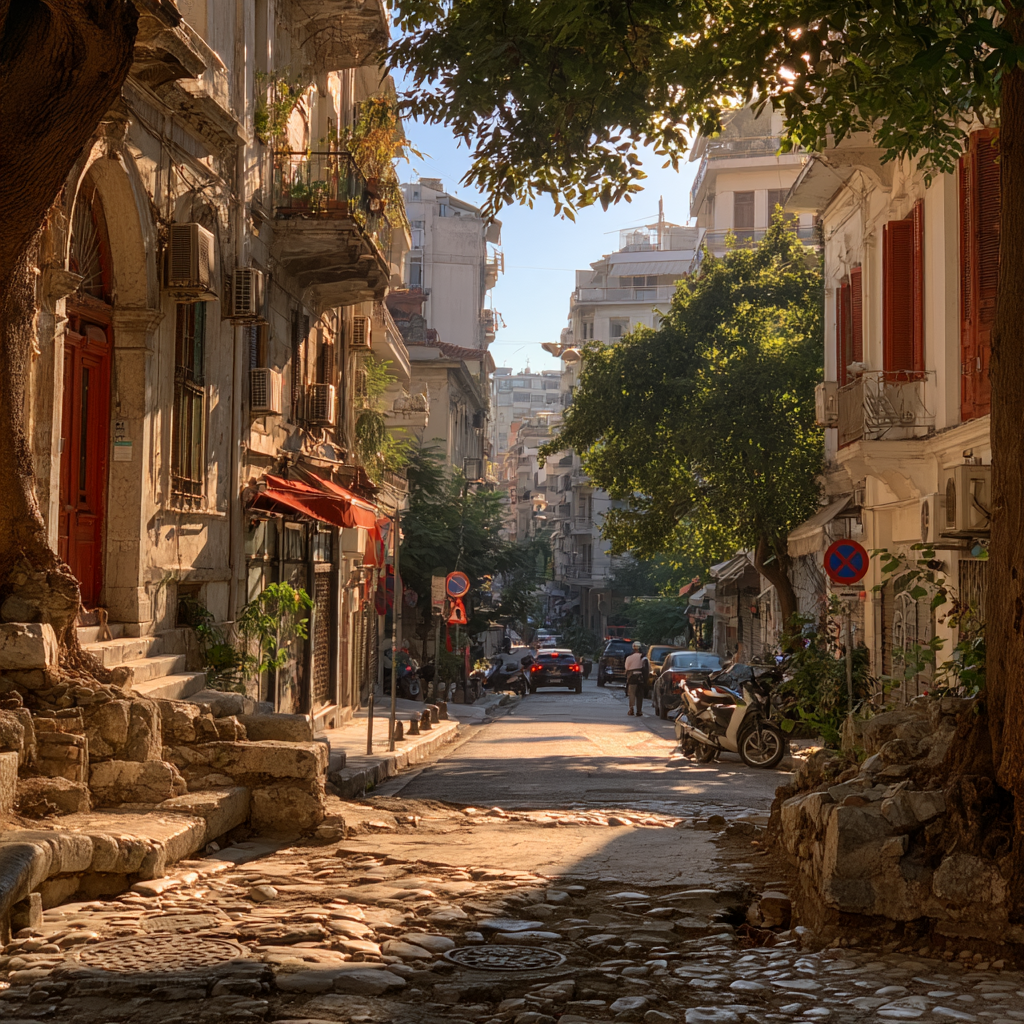
Walk through central Thessaloniki today and it is easy to miss it completely.
There is no Colosseum rising above the rooftops. No grand entrance. No enormous archaeological park.
Instead, there are apartment buildings, narrow streets, cafés, parked scooters and small city squares.
And underneath them — sometimes literally inside the basements of modern buildings — survive pieces of what was once one of Roman Thessaloniki’s largest monuments.
The city’s hippodrome.
It formed part of the enormous imperial complex created when the Roman emperor Galerius made Thessaloniki one of his principal residences around the beginning of the 4th century.
His palace, the Rotunda and the triumphal arch known today as Kamara were all part of the same monumental landscape.
The hippodrome stood immediately beside the imperial palace and stretched for more than 400 metres through what is now the modern city centre.
Today only fragments remain visible.
That disappearance is precisely what makes the place fascinating.
Imagine this neighbourhood 1,700 years ago
Instead of apartment blocks, imagine a huge arena filled with spectators.
Chariot racing was one of the great mass entertainments of the Roman world. A hippodrome was not simply a sports venue.
It was also a place where thousands of citizens gathered, where imperial power was displayed and where the relationship between rulers and the crowd could become very public.
The location beside Galerius’ palace was no accident.
The emperor could move between the imperial residence and the arena as part of the same ceremonial complex.
Today you can walk from the visible ruins of the Galerian Palace around Navarinou Square toward Hippodromiou Square in just a few minutes.
In Roman Thessaloniki, you would effectively have been walking through one enormous imperial district.
Then came the year 390
The hippodrome is also associated with one of the darkest episodes in the history of late Roman Thessaloniki.
In AD 390, unrest in the city resulted in the killing of a senior Roman military official.
Emperor Theodosius I subsequently ordered punishment of Thessaloniki, and thousands of inhabitants were killed.
Later accounts connect the massacre with the city’s hippodrome.
A figure of around 7,000 victims is often repeated, although ancient sources differ and historians treat some details cautiously.
That distinction matters.
The dramatic version often retold today — exactly how people were gathered, whether spectators were deliberately lured into the hippodrome, what role a popular charioteer played and precisely how many people died — cannot be reconstructed with complete certainty.
What is clear is grim enough: serious unrest occurred in Thessaloniki, an imperial official was killed, and the retaliation that followed caused the deaths of a very large number of people.
The strange part: the hippodrome never completely disappeared
Most of its visible monumentality vanished.
But its footprint remains embedded in modern Thessaloniki.
There is still a street called Hippodromiou — Ιπποδρομίου.
Fragments of the ancient structure survive among the blocks around Hippodromiou Square, Dimitriou Gounari, Filikis Eterias and Agapinou streets.
Some remains are hidden inside courtyards and basements.
A small visible section of the western side survives near Fanarioton Square, east of the Nea Panagia church.
That makes this one of those rare archaeological sites you do not really “visit”.
You discover it inside the living city.
How to find its traces today
A good way to understand the lost hippodrome is to begin at Navarinou Square, beside the visible ruins of Galerius’ Palace.
Spend a few minutes looking at the palace remains first.
They help establish the scale of the imperial complex.
Then walk toward Hippodromiou Square.
Do not expect an obvious archaeological attraction.
That is part of the experience.
Look at the shape of the neighbourhood, the streets and the spaces between the buildings.
Continue toward Fanarioton Square and the Nea Panagia church, where one of the surviving fragments of the western side of the hippodrome can still be found.
The walk is short.
But once you know what used to stand here, the neighbourhood feels completely different.
Why this place feels different from Thessaloniki’s famous monuments
Thessaloniki is full of spectacular remains.
The White Tower is impossible to ignore.
The Rotunda survives almost intact.
Kamara still rises above one of the busiest streets in the city.
The hippodrome is different.
You have to reconstruct it in your imagination.
People live above it.
Cars pass over it.
Someone drinks coffee a few metres from stones that once belonged to one of the great public arenas of Roman Thessaloniki.
It is not preserved outside modern life.
It is trapped inside it.
And perhaps that is one of the most fascinating things about Thessaloniki.
This city rarely keeps its history neatly separated inside museums.
Quite often, it is simply beneath your feet.
Dan’s note
If you are visiting the Rotunda, Kamara and Galerius’ Palace, do not stop there.
Walk another few minutes through Hippodromiou.
There may be much less to photograph.
But once you know what happened here — and what still survives beneath the neighbourhood — it becomes one of the most intriguing short walks in central Thessaloniki.
Plan your trip
All Thessaloniki Tours & Excursions ↗
Some links are affiliate links. I may earn a commission at no extra cost to you.