Chios Mastiha: The Greek Resin Collected Like Tears
On southern Chios, farmers still make tiny cuts in mastic trees and wait for drops of aromatic resin to harden like tears — a tradition found nowhere else quite like this.
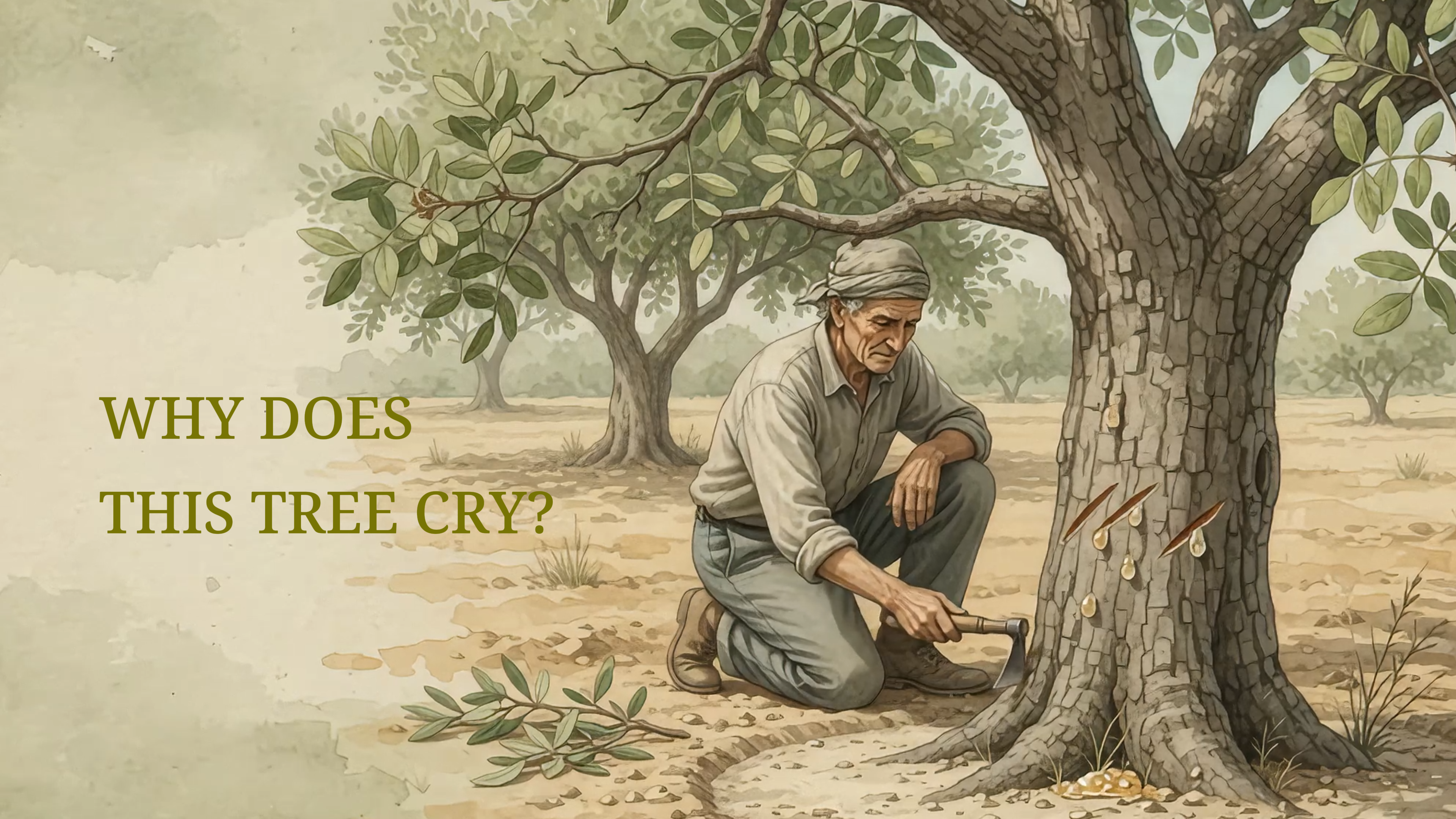
In southern Chios, there is a strange moment every summer when trees begin to “cry”.
Small cuts are made in their trunks and branches.
Clear resin slowly appears.
Some drops remain on the bark. Others fall toward the carefully prepared ground below.
Then they harden.
The people of Chios call these pieces tears.
And they are the source of one of Greece’s most unusual products:
Chios mastiha.
A tree that grows elsewhere — but behaves differently here
The mastic tree, Pistacia lentiscus, is not unique to Chios.
Related shrubs grow across the Mediterranean.
That makes the real story much more interesting.
It is not simply that Chios has a rare tree.
It is that on the southern part of this particular island, a combination of the local variety, climate, soil and centuries of cultivation produces the aromatic resin known as Chios mastiha.
The Chios Mastiha Growers Association describes southern Chios as the place where this tradition developed into something unique.
Attempts to reproduce the same result elsewhere have never created the same agricultural culture or product.
This is why the southern part of the island is known as the Mastichochoria — the Mastic Villages.
First, the ground is prepared
Harvesting mastiha does not begin with cutting the tree.
It begins underneath it.
From around mid-June, growers clean and level the soil surrounding each trunk.
The surface has to be prepared carefully so that resin falling from the tree can later be collected without becoming mixed with earth and debris.
Traditionally, a pale mineral material is spread beneath the tree, creating a clean surface.
Only after this preparation begins the part that has made the mastic tree famous.
The cutting.
The tree is carefully “wounded”
From July onward, growers make a series of small incisions in the bark and main branches using a special sharp tool.
Not one deep cut.
Many controlled, shallow ones.
From these tiny wounds the resin begins to emerge.
At first it is clear and sticky.
Slowly, gravity pulls it downward.
Some droplets hang from the bark.
Some fall.
Over the following days they solidify into irregular translucent pieces.
This is where the poetic description comes from.
The tree appears to be crying.
And the hardened resin becomes its tears.
But collecting the tears is only the beginning
Once hardened, the mastiha is gathered carefully.
Then comes the slow work that visitors rarely hear about.
Sorting.
Washing.
Cleaning.
Piece by piece.
UNESCO describes mastic cultivation as a family occupation involving different generations and stages of work throughout the year.
Traditionally, much of the cleaning and sorting has been done by women, while skills connected with pruning, cutting and harvesting have been passed from older growers to younger ones.
This is not simply agricultural production.
It is knowledge transferred within families and villages.
That is one reason UNESCO placed the know-how of cultivating mastic on Chios on its Representative List of the Intangible Cultural Heritage of Humanity in 2014.
Twenty-four villages built around one strange resin
Southern Chios contains a group of settlements historically associated with mastiha production.
They are known as the Mastichochoria.
Many developed as fortified or fortress-like villages.
Mesta is perhaps the most striking example, with narrow lanes, stone passages and houses arranged as part of a defensive settlement.
Pyrgi is completely different.
Its façades are covered with the famous black-and-white geometric decorations known as xysta.
Olimpi preserves another version of the medieval village structure.
Mastiha was valuable enough that control of its production helped shape the history, economy and even architecture of this part of Chios.
Under both Genoese and Ottoman rule, the resin was important enough to influence taxation and administration.
So when you walk through these villages, you are not simply seeing pretty medieval streets.
You are walking through communities whose form was deeply connected with one agricultural product.
Why Chios mastiha tastes so unusual
If you have never tasted pure mastiha, the flavour can be surprising.
It begins slightly bitter.
Then something resinous, pine-like and almost herbal appears.
There is nothing quite like it.
It can be used in sweets, ice cream, breads, pastries, chewing gum and drinks.
It also flavours the well-known Greek mastiha liqueur.
But buying a bottle of liqueur tells only a small part of the story.
The more interesting experience is tasting mastiha after seeing where it comes from.
Suddenly the flavour is connected to a landscape.
To dry southern hills.
To medieval villages.
To trees with pale ground beneath them.
And to hours of very patient work.
Where to understand the story properly
If you are travelling through southern Chios, one of the best places to begin is the Chios Mastic Museum, close to Pyrgi.
The museum explains the entire process — the tree, cultivation, harvesting, cleaning, cooperative production and the role mastiha played in shaping the Mastichochoria.
There is also an outdoor section where visitors can see the plant itself.
After that, continue into the villages.
Pyrgi is the obvious stop for its extraordinary decorated houses.
Mesta is worth visiting for its fortress-like medieval layout.
Olimpi gives another sense of what these protected agricultural communities once looked like.
The museum gives you the explanation.
The villages give you the atmosphere.
The detail worth remembering
Mastiha is often sold as a Greek flavour.
That is true.
But it undersells the story.
This is not simply an ingredient associated with Greece.
It is a product tied to one very specific cultural landscape on one island.
A landscape where families still prepare the soil beneath their trees.
Where small cuts are made by hand.
Where drops of resin slowly harden in the summer heat.
And where people have spent generations collecting something that looks almost insignificant.
A tiny translucent tear.
Dan’s note
If you visit Chios, do not only buy mastiha in a shop in Chios Town.
Go south.
Visit the Mastic Museum, then drive through the Mastichochoria.
Once you have seen the trees and understood how much work goes into producing those tiny pieces of resin, mastiha stops being a souvenir.
It becomes part of the island itself.
Watch the story
Watch on YouTube ↗Plan your trip
Some links are affiliate links. I may earn a commission at no extra cost to you.
Enjoyed this little corner of Greece? You can buy me a coffee.